THE FIRST CHAPTER
The Chronicle
Long before foreign sails reached the horizon, Orunai-Wipó already held centuries of history, rivalries, and mysteries.
I · BEFORE THE CROWNS
The Homeland of the Turning Waters
Long before distant empires ventured into these waters, the islands now called Crownbreak Cove were known to their inhabitants as Orunai-Wipó: the Homeland of the Turning Waters.
Across these distant South Sea islands, sheltered coves were home to fishing villages, navigators, craftspeople, and traders. Mist-fed forests climbed toward towering cliffs enclosing hidden valleys and caves which different island communities regarded with reverence, dread, or guarded curiosity.
Among the most mysterious places in their homeland was Ulavé, “the Breathing Stone”—an immense labyrinth of jagged sea cliffs, hidden channels, and ancient caverns. Generations later, foreign sailors would give these treacherous waters another name: the Shattered Teeth.
But to the Aruwai, Ulavé was far more than a danger to passing ships. It was an ancestral place of reverence, forbidden passages, and stories older than any foreign kingdom.
Across the wider ocean, seafarers from distant island worlds had long undertaken deliberate voyages guided by stars, wind, birds, and the movement of the swells. Some old Aruwai accounts remember visitors arriving from the west in great sailing canoes, exchanging gifts and knowledge of the sea before departing again. The people of Orunai-Wipó were already at home here; whether any of those distant voyagers settled, returned, or became part of the islands' later communities remains a subject of competing traditions.
Among the oldest warnings were stories of a hungry darkness beneath Ulavé's stone. Some feared an ancient evil sleeping in the caverns; others regarded the deep places as sacred, perilous, or simply forbidden. No single account speaks for every island community, and none settles what truly waits below.
The islanders were not one people with one belief. Alliances were forged and broken; customs differed from village to village, and some ancestral territories were fiercely defended. They were bound together not by an empire, but by the geography and memory of their homeland.
Here the tides did not always behave as sailors expected. At times a distant voice seemed to travel through empty stone. Unfamiliar lights appeared far beneath the sea. Some mysteries had practical explanations. Others had been passed down through generations without an answer.
Certain passages were sealed. Some waters were avoided. Their oldest stories warned against disturbing whatever lay below the cliffs.
A CHART OF THE OUTER OCEAN
Where the South Sea Ends
Far from the continental coasts to the east and the scattered island realms of the central South Sea to the west, the archipelago rises in a lonely reach of the southeastern Pacific where foreign sailing directions grow uncertain. It is a voyage of many weeks from the nearest imperial ports. High black cliffs catch the rain and cloud; green ravines shelter settlements from the winds; reefs and contrary tides turn a promising anchorage into a graveyard.
These islands were never unknown to their own peoples. Aruwai mariners learned the stars, seasons, passages, and warnings of Orunai-Wipó long before foreign pilots carried their uncertain charts into the far South Seas. Across the archipelago, different island communities kept distinct routes and traditions. Ulavé names only the ancient cliff-and-cavern region later called the Shattered Teeth—not the whole homeland.
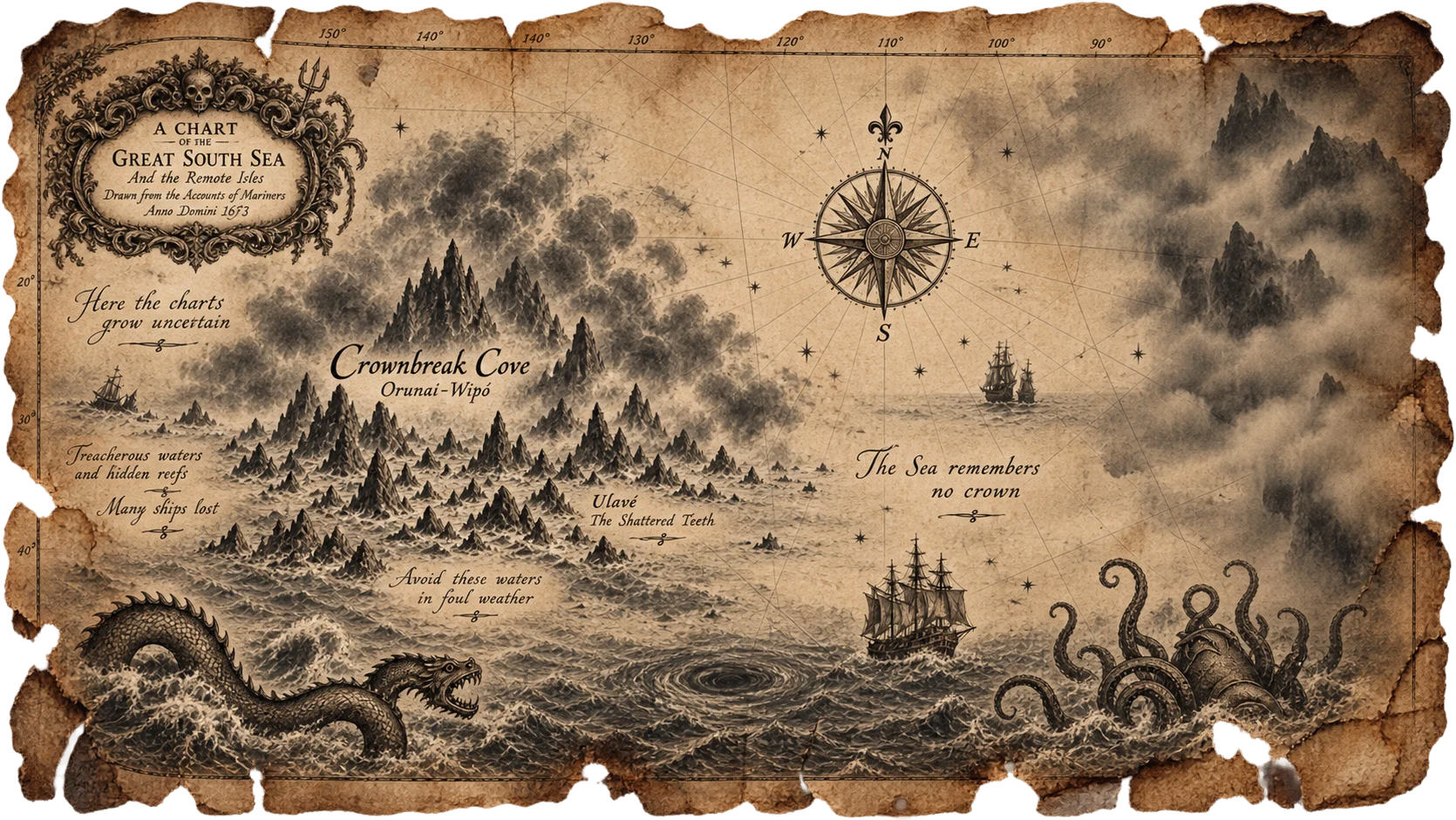
Beyond the last sure sounding, where the charted waters cease,A crown of cliffs breaks through the mist and grants no sailor peace.There the cliffs have teeth, the hidden caverns breathe,And every turning tide conceals what slumbers underneath.The captain marks his sovereign’s claim; the waves erase the line.The people knew these shores of old, before the seal and sign.
The sea remembers no crown.
The outsiders did not bring the mystery. They stumbled into it.
II · VOYAGES & FOREIGN SAILS
A Harbor of Broken Claims
For ages before European pilots entered the South Sea, island navigators had already crossed its vast reaches and maintained their own routes and histories. European ships passed through the strait at the foot of South America in 1520, but no surviving historical record places Magellan's voyage at these fictional islands. In Crownbreak's own history, the first recorded European landing came from Portuguese mariners around 1524, carried far off the familiar Pacific routes. Their little watering station did not begin the islands' story; it merely marked a new and disruptive chapter in a much older homeland.
Decades later, Spanish forces seized that foothold after years of fighting. They raised a chapel above the cliffs and built the settlement remembered as La Corona Vieja. Yet no foreign flag commanded every passage. The Aruwai maintained their own territories and rivalries, sometimes trading with newcomers, sometimes resisting their claims.
As Iberian treasure routes spread along the Pacific coast of the Americas, raiders and explorers came through the southern passages into the South Sea. Far from the ordinary lanes to Peru, New Spain, and the distant islands beyond, Crownbreak became a disputed anchorage for privateers, fugitives, armed merchants, and mariners with nowhere else to make landfall. Its recent history was written in wreckage, shifting allegiances, and graves.
Voyagers Before the Charts
For countless generations, the Aruwai and other peoples of Orunai-Wipó navigate their ancestral seas and preserve the memory of distant journeys. Old accounts also tell of great canoes coming from island worlds far to the west, guided by stars and ocean swells. Some visitors trade stories and knowledge with coastal communities; others turn away after hearing warnings of a darkness hidden beneath the cliffs of Ulavé. Whether these strangers settled, sailed home, or vanished into other histories remains uncertain.
The Portuguese Landing
A Portuguese-led crew strays far into the South Sea and establishes the first recorded foreign watering station. The islanders have lived, voyaged, and traded here for generations before their arrival.
The Spanish Conquest
After a protracted struggle with Portuguese defenders, Spain takes the harbor. A chapel and fortified settlement follow, but the Crown never subdues the entire archipelago.
The Hollowmouth Feast
A Dutch ship seeking freshwater sends nineteen armed sailors ashore beneath the cliffs of Ulavé. None returns. Searchers find an overturned boat, shattered muskets, and human bones among the blackened fires of a hidden cavern. The surviving ship's journal blames the Varkuró; later tales insist the entire party was slaughtered and devoured. No one who landed survived to tell what happened inside.
The Battle of the Black Narrows
Following the dangerous South Sea tracks pioneered by earlier English raiders, an English expedition makes a long passage around the southern end of America and attempts to seize Crownbreak's old Spanish anchorage. Spanish defenders, storms, sickness, and the independent resistance of some Aruwai communities drive the expedition back to sea. Its broken guns and graves are not forgotten.
The Night of Broken Chains
Far from the established Pacific ports, enslaved Africans aboard the Portuguese vessel Nossa Senhora da Piedade rise against their captors during an illicit South Sea voyage. Fire destroys the ship; some die, while others reach the islands and build free lives, sometimes finding refuge and allies among Aruwai settlements.
The Founding of Fort Greywatch
The English Crown returns and occupies an older fortified height at the harbor. Reusing Spanish masonry, its soldiers begin raising the stone walls, towers, and batteries of Fort Greywatch. The first English defeat remains a bitter memory.
The Battle of Three Flags
Far from the European war's main theaters, a Dutch armed merchantman seeks shelter from an English privateer and its French ally. The distant Anglo-Dutch conflict has followed the rival vessels into the South Sea. With clandestine help from certain Spanish merchants, the struggle turns Crownbreak's channel into burning wreckage. The English guns of Greywatch cannot prevent the destruction.
The Great Pestilence
In the aftermath of the Battle of Three Flags, a merchant vessel enters Crownbreak carrying more than provisions. Soon black rats swarm the warehouses, and a mysterious fever spreads through the harbor. The English garrison seals Fort Greywatch’s gates. Ships refuse to dock, homes stand empty, and the bells of the old Spanish chapel toll for the dead. Those who survived called it the Great Pestilence, or simply the Pestilence of ’74. Whether the sickness came aboard that ship—or had already taken root upon the islands—remains bitterly disputed.
To sailors, the name Crownbreak Cove grew into a warning: a place where governments could claim the shore, yet seldom keep what lay beyond their cannon.
III · OUR PRESENT
The Year 1676
Seven years after its founding, Fort Greywatch rises above the anchorage: an imposing English stone fortress built upon older Iberian defenses. Its high walls, towers, and great gun batteries are a declaration of the King's authority. More masonry is still being laid, and the Crown's hold remains secure only where its guns can reach.
The harbor is recovering from battle and the Great Pestilence. Supply ships travel perilously far from Pacific America, often arriving weeks later than promised—or never arriving at all. Spanish families retain memories of former dominion; Portuguese merchants guard their ledgers; Dutch and French captains watch one another across the quay. Pirates, deserters, and smugglers find cover among the outer islands. Survivors of the Piedade and their descendants defend the freedom they fought to win.
Beyond the fort, Aruwai communities continue to govern their own lives and ancestral places. The ruins of La Corona Vieja look down upon the sea, while the caverns and channels of Ulavé—the Shattered Teeth to foreign sailors—keep mysteries older than every foreign claim.
Many crowns have reached Crownbreak. None has yet conquered its secrets.
Crownbreak Cove is fictional, placed in a deliberately remote reach of the southeastern Pacific. Across the real Pacific, Polynesian navigators made extraordinary long-distance voyages for centuries before European ships arrived, reading the stars, winds, birds, and ocean swells. Their maritime history informs Crownbreak's imagined tales of ancestral visitors from the western island worlds; no historical record places those voyagers at this fictional archipelago. The local peoples, battles, ships, settlements, and supernatural traditions are invented. Later background draws on Magellan's entry into the Pacific, English voyages along Spanish America's western coast, Dutch South Sea expeditions, and distant European rivalries. The history of Orunai-Wipó began long before any foreign chart recorded its shores.